The situation
Smither Psychiatry needed a trustworthy practice website, clearer patient-facing copy, a local SEO structure that could rank for the conditions Morgan treats, and someone to handle ongoing updates as the practice details changed.
Healthcare sites have a small margin for error. Patients are choosing whether to trust the practice in about thirty seconds. A site that buries credentials, hides services, or feels generic can quietly cost real bookings.
What I built
- The practice website from scratch on a clean, fast, mobile-friendly structure.
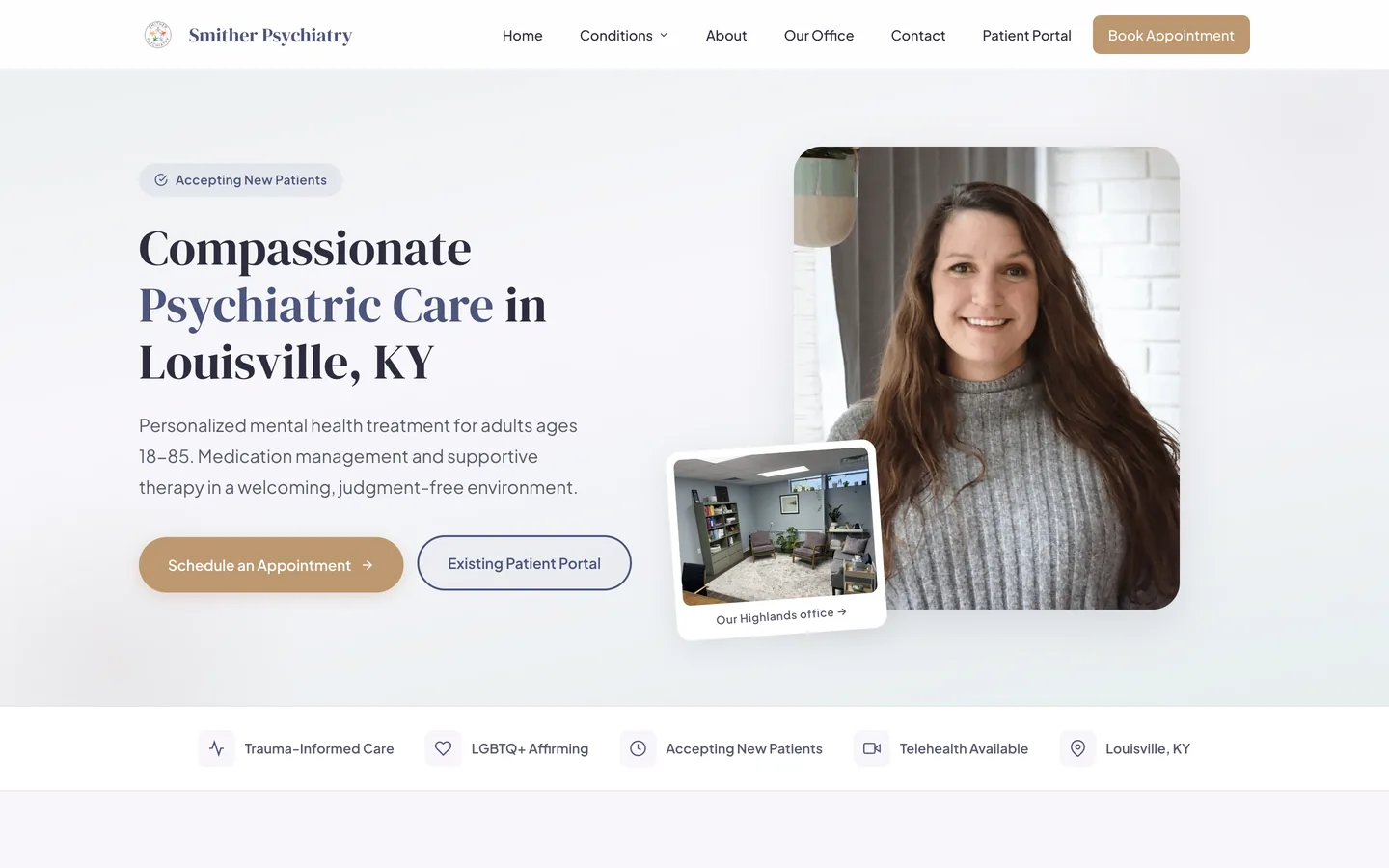
- A homepage that leads with trust cues, services, and a clear next step for new patients.
- Condition pages so people searching for specific care can find a real answer instead of a sales pitch.
- Local SEO page titles and meta descriptions tied to how Louisville patients actually search.
- Google Analytics 4 and Google Search Console set up from day one.
- Footer cleanup and small trust-signal fixes that quietly add up.
What the numbers did
The site launched in December 2025. By June 2026 Google was showing it to roughly five and a half times as many people each month, and the average position had recovered from a spring slump.
Where these come from: Google Search Console for the practice, pulled during the technical audits dated June 30 and July 3, 2026. Two notes so nobody reads more into them than they should. Search Console average position is impression-weighted and leans local, so it is not the same thing as a page-one ranking on a clean national search. And these are visibility numbers, not patient numbers. Patient volume belongs to Morgan and is hers to share.
What I actually fixed
The June audit found a handful of specific, boring problems. Boring problems are usually the ones costing you traffic.
- The duplicate URL bug Every page was reachable at two addresses, the clean URL and the old .html version. Google was splitting the ranking signal between them. I set canonicals, forced 301 redirects, and rebuilt the sitemap so each page has exactly one address.
- Structured data, from zero The site had no schema at all. I added MedicalBusiness, Person, and WebSite markup on the homepage, and MedicalWebPage plus MedicalCondition markup on all eight condition pages, so Google can tell what the practice is and what it treats.
- Eight condition pages, re-skinned The homepage had been redesigned but the condition pages were still on the old 2025 template. I rebuilt all eight into the current design system so the site stops looking like two different sites.
- Meta hygiene All nine meta descriptions were trimmed under 155 characters so Google stops cutting them off mid-sentence. Two page titles that were running past 74 characters got the same treatment.
- Image weight The two staff headshots were the heaviest things on the page. Converted to WebP: 336KB down to 77KB, and 404KB down to 107KB. That is most of a megabyte off the pages patients load first.
- Real photos of the real office Morgan sent me photos of the actual office. Four of them went into a new office section, replacing the generic feel that every healthcare template has.
Where it stands now
The site refresh shipped in July 2026. Everything in the fix list above went live in that push.
Average position moves week to week; small swings are noise. What matters is that the practice sits on page 1 for the term patients actually type, and stays there.
One thing is still open. The practice profile got merged with another listing in Google Maps, and a merge is something only Google can undo. I filed the case and it's pending. Until it clears, the map pack is working against a listing that isn't cleanly hers, so I'd rather say that on the page than leave it off.
Where these come from: Google Search Console for the practice, and the support case I filed with Google. Average position is a reporting-window average, not a fixed rank, and it moves. These are visibility numbers, not patient numbers. No patient information appears anywhere on this page and none of it would be mine to publish.
What's next
Branded search performs well. When somebody already knows Morgan's name, they find her.
The open work is non-branded discovery, the searches where a patient describes a condition instead of naming a provider. Those queries pull impressions today and not many clicks, which is exactly the pattern you see right before a page starts converting. That is the next push.
This is also the kind of site that justifies a monthly relationship. Practice details change. Hours move. New conditions get added. The site gets to keep up with all of that without Morgan having to touch it.
The pattern this fits
This is the local practice website pattern. It works the same way for therapy, chiropractic, dental, med spa, physical therapy, and other appointment-based local healthcare and wellness practices.
If your practice needs a real site instead of a template, ongoing updates without a portal, and a search structure that actually attracts the right patients, this is the kind of project I do well.